
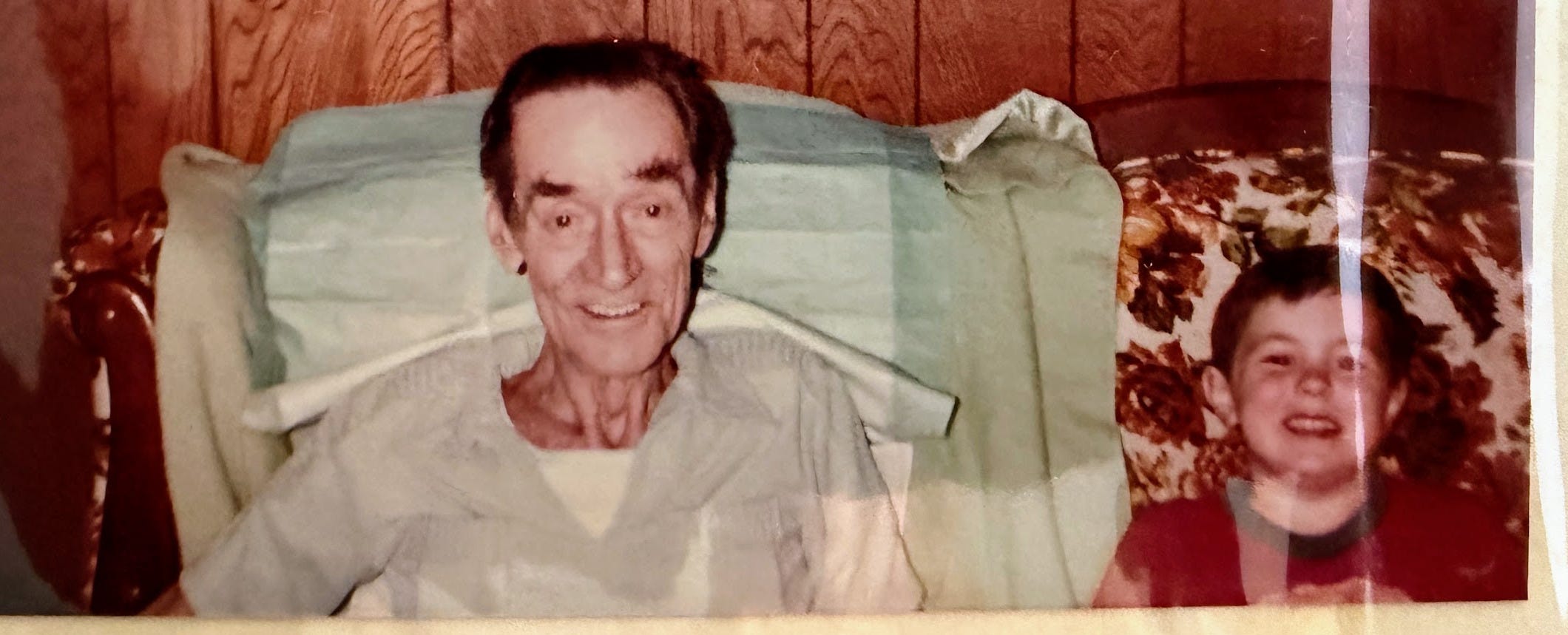
Before my grandfather got sick and couldn’t leave the house, my parents would take me to his suburban home so they — and he — could go to work while I watched soap operas with my grandmother. Hours later, like a dog who knows when their owner has turned the car onto their street, I would hear the key enter the lock and race to the front door, chubby arms extended and fat stomach racing toward his thin legs. He’d see me, smile, and say “hey buddy” in his Scottish brogue. People would tell me they had difficulty understanding him, but for those ten years I had with him, I understood every word he spoke.
After he could pry me from his legs, my grandpa would drop his briefcase and we’d kick an orange-sized rainbow-colored rubber ball inside his house. I would stand with my back to the wooden front door while he stood underneath a six-foot-wide area that connected the den to the living room. If his shot touched the door and the metallic chimes attached to the entrance rang, he got a goal; if my shot rolled under the brown wooden archway and into the room where my grandma was watching her stories, I got a goal.
Had we been playing fairly, I never would have scored on my grandfather and he would have scored every time he kicked the ball. But we weren’t playing fairly. I’d kick the ball toward him and my grandpa would twist his arms, body, and legs, flailing as if my shot was too fast to stop. I would scream when I scored, arms raised over my faded Pac-Man t-shirt, and jump up and down, exposing the roll of pale, pasty fat hanging over my corduroy OP shorts like I had just won the World Cup because, to me, at that moment, I had.
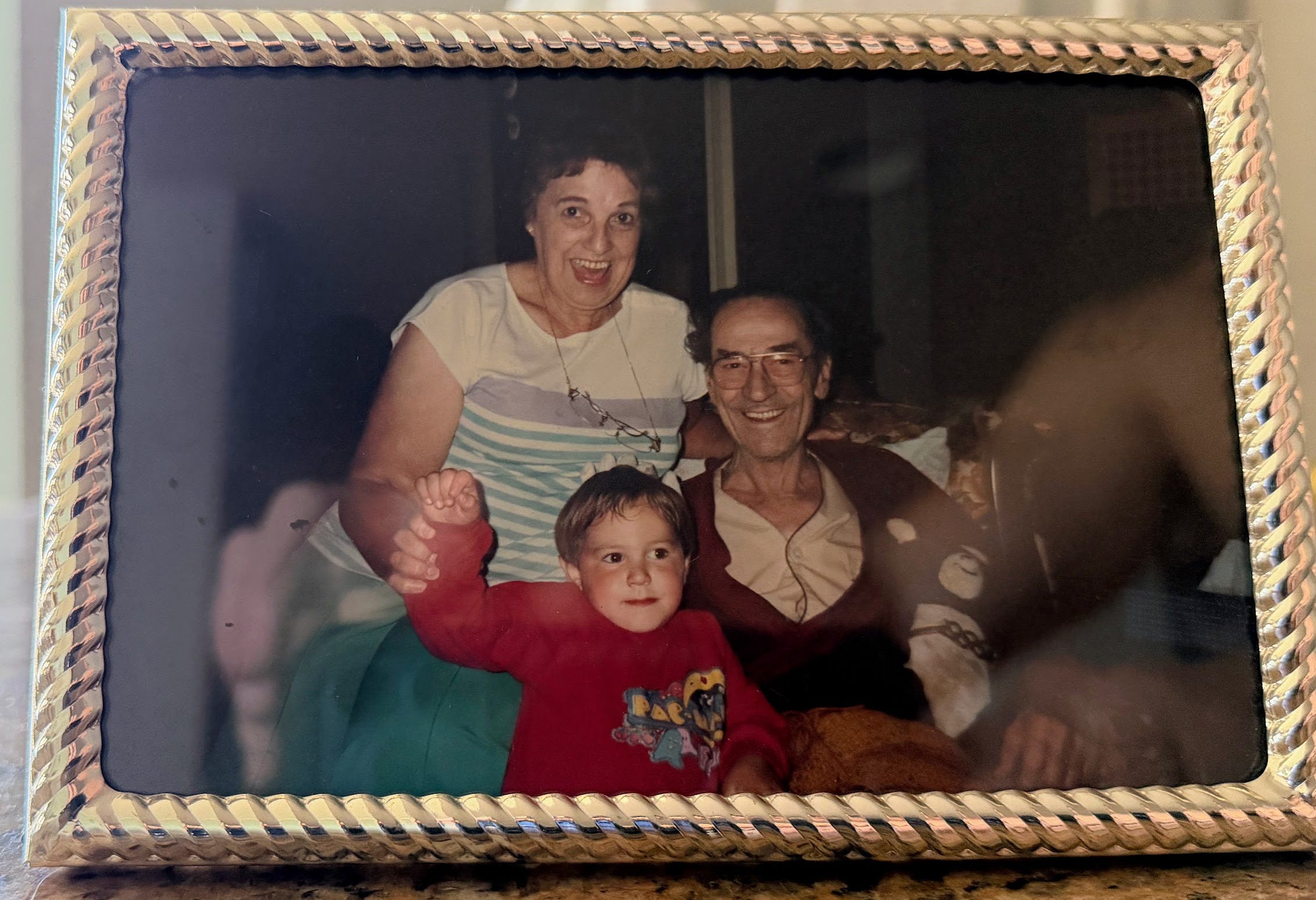
“Do you want to play soccer?” my parents asked based on these living room matches. My grandfather, who was my hero, my idol, my everything, a man for whom I would have done anything, was born in Aberdeen, Scotland and loved the sport he called “football.” My grandfather wasn’t just my dad’s dad — he was my equal. A pal. A best friend. Naturally, I said yes because I assumed I’d enjoy AYSO.
I was wrong.
For two seasons, I was positioned at defenseman. Parents might not know this, but eight-year-olds understand more than they let on. Whenever the coach put me at defenseman, I knew what he was really saying because when you’re eight and you play defenseman for AYSO, you’re fat or you’re terrible. I was both.
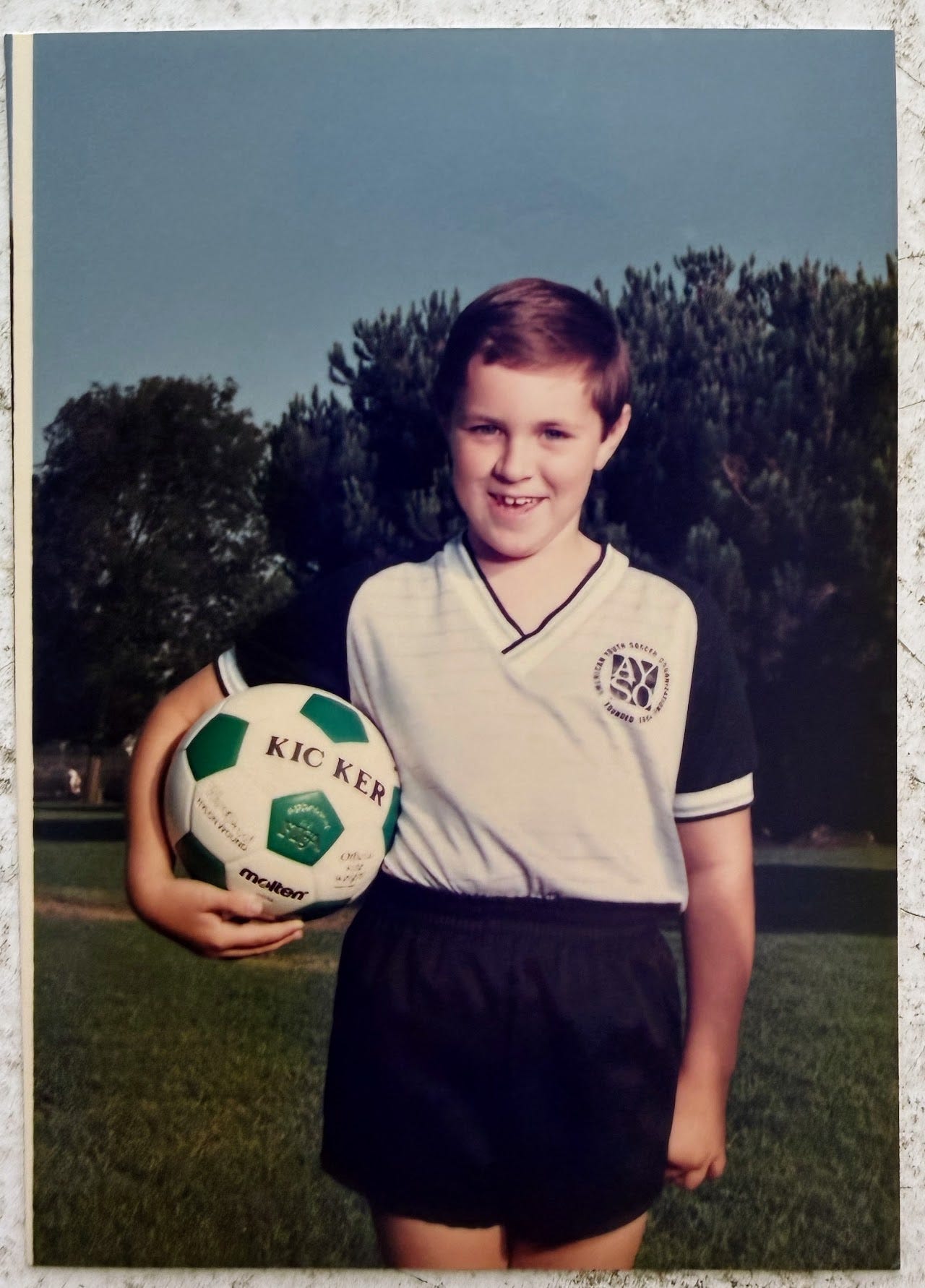
Soccer became an abusive relationship, the kind that reminded me I was fat and slow. I knew from experience that being called fat was a different kind of insult than “your breath smells” or “you’re stupid.” The first time was at a grocery store. A stranger approached my mom to ask if I was Peter, the chubby kid from The Cosby Show. My mom explained that I wasn’t. This encounter might have made sense if it occurred on Sunset Boulevard or maybe somewhere in Santa Monica. I was approximately six years old, age appropriate for the role. I was pasty and pale. I had floppy brown hair. It’s totally possible, in the right location, the right context, that I could have been Peter from The Cosby Show, but we weren’t anywhere near Hollywood. We were at the intersection of Western Avenue and Lomita Boulevard. The fat kid from The Cosby Show might not have been an A-lister, but he wasn’t shopping at the Alpha Beta in Lomita, a suburb twenty-six miles from Tinsel Town.
During my second season, my soccer team had a game at the Fabulous Forum in Inglewood, California. I was ecstatic because the Lakers played at that arena and I too was participating in a group activity that was to resemble athletics. More specifically, Magic Johnson played at the Forum, and there wasn’t a bigger fan of his than I.
Sadly, Magic Johnson wouldn’t be in attendance that day. The Los Angeles Lazers, a professional soccer team in the Major Indoor Soccer League, would be, as our match was the warm-up act for the contest between the Lazers and whatever team the Lazers were playing that afternoon.
My grandfather was also not in attendance. By the time I first stepped onto the pitch, my grandpa had colon cancer and was a rail-thin man with constant day-old stubble covering his bony cheeks. My memory tells me that he made it to only a few games during my first season and none during my second. Considering how bad I was, I don’t know what he would have thought about my abilities. Perhaps his fat American grandson with the clumsy footwork would have embarrassed the proud Scot. But probably not. I’m sure he would have smiled, cheered, and thought of me as the MVP.
“Ritchie, you’re goalie,” the coach said as we warmed up on the Forum AstroTurf, a decision I still don’t understand because I had never played nor practiced the position.
I was insecure, scared I’d fail, afraid of being teased because I’ve always felt insecure, always been scared I’ll fail, of being teased. I didn’t like being the overweight kid who couldn’t be trusted to run the length of the field, the insecurity I felt playing soccer mirroring the insecurity I felt at school, the beach, the mall, the movies, family gatherings. Anywhere, really. The exception was whenever I was with my grandfather, who made me feel like the most important person alive. Without him at my games, soccer became nothing more than another reminder that I was the opposite of thin, which, for all I knew at the time, was the absolute worst thing a person could be.
AYSO was an emotional disaster to which I never returned, but still I wanted to kick the rubber ball with my grandpa. I asked him things such as “when you get better…” and finished those statements with “can we kick the ball?” or “can we go to the zoo?” Things we used to do when he was healthy. However, by this stage of his life, the only thing he could do was take three steps from the bedroom to his seat in the living room. And even then he needed a walker.
Regardless of what happens to me for the remainder of my life, these moments with my grandfather are my Rosebud.
I didn’t know my grandfather would never again play soccer with me inside his house, walk through the front door, go with me to the park, or take the train to the Hearst Castle. He was bedridden, dying, I didn’t see it, and no one told me.
My grandpa’s illness-induced retirement helped us grow even closer. I would charge through the front door and run to his side of the mattress, where he would be lying on his right, facing the doorway. He must have been in pain, certain he was dying. He had every right to be miserable, to count the days until his passing, to ask for booze and cigarettes because unhealthy habits didn’t matter anymore, but when I entered his home and ran to his bedside, he was nothing but smiles. Our roles had been reversed.
And then he died.
I was on vacation with my mom’s side of the family, camping in the middle of northern California near Reno, Nevada. My cousins and I rode bikes and played near a creek. For a kid on summer break, it was a great way to vacation.
At some point that week my aunt drove us to the general store, where I bought two Teenage Mutant Ninja Turtles books with the twenty dollars my grandfather had given me before the trip. The store had four books for sale, but I bought only two. When we returned to the store a few days later, I saw the remaining books and thought my grandpa would like it if I bought all four of them, so I did. I was happy about my purchases and couldn’t wait to show him what I bought with the money he gave me.
One night my aunt told me she had to take me home. I thought nothing of this information, but if I was maybe two years older, I might have understood that something was wrong. She drove overnight in her truck for approximately eight hours, leaving behind her son, her parents, and all the fun we were having.
I got home the next morning and went into my room, where my younger brother was playing my Nintendo. He sat on the floor while I sat on the bed. The door was open. My parents stood in the archway, my mother in front of my father, whose right arm was leaning against the wall. My mom entered first, my dad a step behind. One of them, I don’t remember, said they had something to tell me. They approached the bed and said my grandfather had died while I was on vacation. Similar to nearly everything surrounding his death, I don’t remember the exact words my parents spoke, but I do remember focusing on my brother’s game, staring, dazed, understanding the words but not understanding the words. My grandpa died. Yeah, and?
Maybe being young and never knowing someone who had died was why I couldn’t comprehend, or maybe I didn’t comprehend because I never knew my grandfather had a sickness from which he couldn’t recover. Now I remember the times my parents telling me he wasn’t well, but those words were meaningless then. Emotionally and intellectually, I never understood what was happening, that he wasn’t sick like I was sick when I had an ear infection, that “sick” meant “dying,” and “dying” meant I would never see him again.
I never think about my grandpa’s death, and I do everything I can never to think about him. I don’t know his birthday or his death anniversary, and my parents have had to remind me multiple times that his favorite dessert was vanilla ice cream with strawberries. I don’t watch reruns of Card Sharks (our favorite game show), I didn’t visit Scotland until I was thirty-seven years old, and I avoid bagpipes because my aunt told me at his funeral that every time I heard them I would think about him and she was right, except she meant “think about him in a good way” but instead bagpipes make me cry.
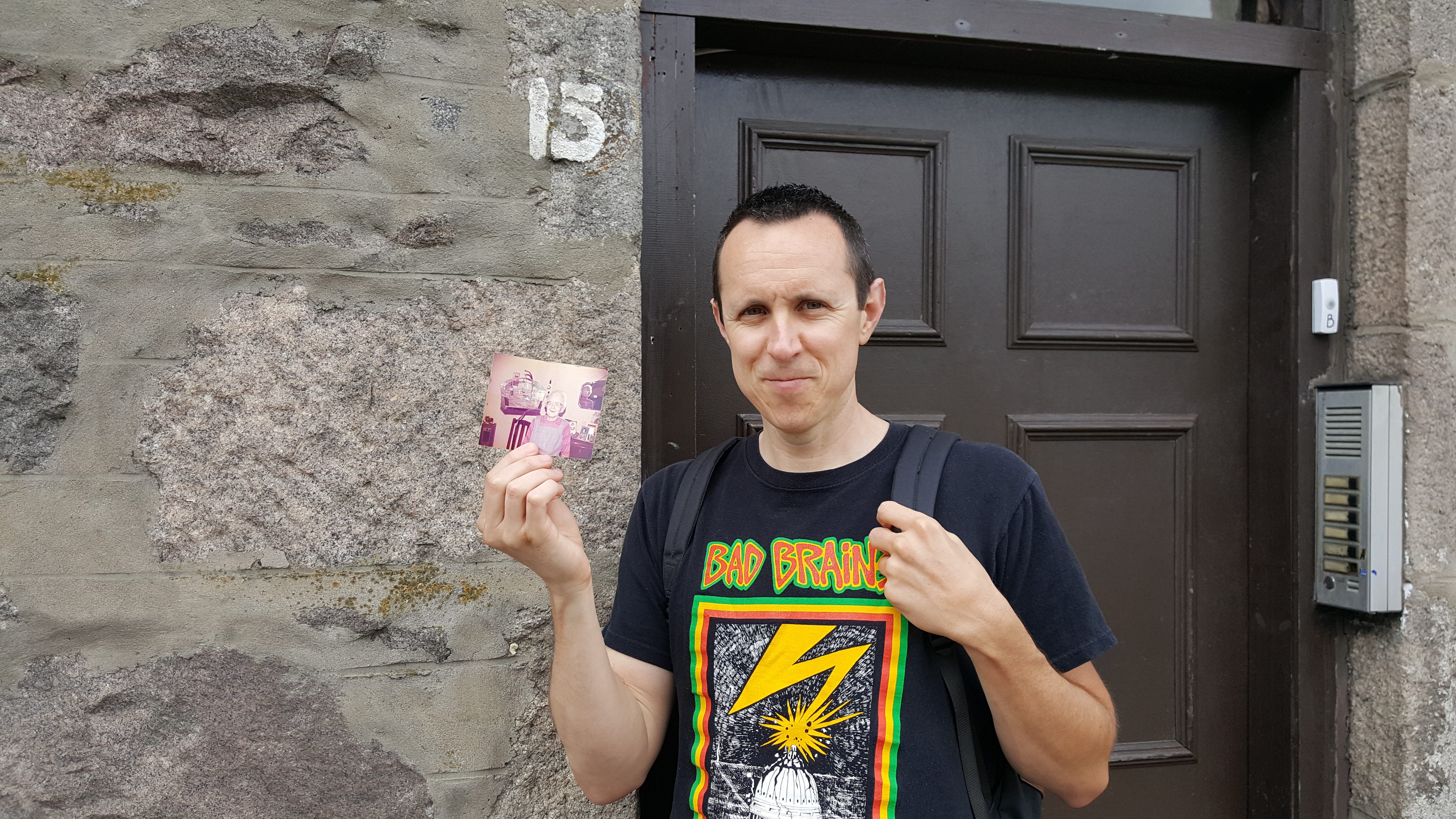
Since my grandfather’s 1990 passing, I’ve grown to despise soccer and mocked the game and anyone who enjoys it. Basically, I hate soccer, but 2026 World Cup matches have been on the television screen above my favorite elliptical at the gym, so I’ve been forced to watch. France, apparently, is pretty good.
The French 3-0 defeat over Sweden reminded me of the opening match of the 2014 FIFA World Cup between Brazil and Croatia, a game I remember for two reasons. First, I had never watched a soccer game on TV and hadn’t since a few days ago at the gym; second, I remember watching the 2014 game at my deceased grandparents’ home, where I lived for seven years following the end of an 11-year relationship.
My legs pumped on the elliptical, but my mind was elsewhere, another buried memory returning. No. No. No. Go away. Not here. Not now. Not at the gym. Not ever.
“He used to be three feet over there,” I remembered telling myself 12 years ago as I watched Brazil versus Croatia.
I heard his accent, felt the stubble on his bony cheeks rubbing against mine, saw his plaid pajamas, tasted the sip of coffee I snuck from his cup when my grandma would take him to the bathroom because I thought coffee was forbidden, something only adults drank (it was nearly a decade later when I realized coffee was served hot).
Returning to that moment on my former couch was not on my to-do list, and definitely not at the gym, but trying not to think about something is a great way to think about something.
A lump appeared in my throat. Tears prevent me from thinking about my grandfather. I hope he understands why.
There are two professional teams in Los Angeles and I’ve been to one Galaxy game because a date wanted to go. I don’t watch highlights on SportsCenter, I don’t follow local teams on social media, and I don’t kick the ball with my friends because for years I’ve said I hated soccer, but now I realize it’s not the sport I hate.
It’s the fact that he’s gone.